
Author: Admin
Julian Kerry

Julian Kerry is living in the house which his great great grandfather Willie Garland bought. He remembers visiting this house since he was a child. The home is Croft Acre, Fersfield which like many homes round here was a small holding.

Julian thinks that Fersfield (unlike Bressingham) has not changed much in appearance as there have been no new buildings. Julian remembers Fersfield had 2 or 3 pubs and a post office – but they are now gone. Does anyone remember these and can tell us something about them? Julian’s grandfather came from South Lopham at Fen Farm and he married one of the Garland sister. They then moved to Willow Farm in Fersfield. Julian’s father lived in a house near Pillar Box Corner, Bressingham. So Julian has lived in either Fersfield or Bressingham most of his life.

His father like Julian was a builder. He worked with Maurice Peachey and they called themselves Kerry and Peachey until 1971 when Julian joined his father and they worked as Kerry and Son. They built another house at Pillar Box Corner and then they bought Drift House in Bressingham which was derelict and which they restored. Later when his father sold the house for £2,000 he spent £1,000 on buy a new Jaquar car! Julian said that as a child he spent a lot of time living in a caravan while his father either built or restored their home.
In 1971 Julian worked with his father as a builder and they became Kerry and Son. During the years Julian and his father did a lot of work in the community including the churches. Julian went to Bressingham School and then on to Diss Grammar. Later when he married he had 3 daughters – 2 live in Norfolk and 1 in Essex. Sadly Julian’s wife died 8 years ago. Julian has a medal which he inherited from his Great Aunt Hilda Garland (who later became Welch).
It is dated 1910 and it is for ‘Regular School Attendance’.

Julian also has the photo of the Stool Ball Club dated 1915. His mother Myra Kelly found this photograph and thought that the girl on the bottom row, third in on the right, is one of the Garland sisters. Julian wonders if there is anyone in the community that can help him identify any of the other girls? If so please be in touch with him via the website email.
I asked Julian in what way things had changed since he as young and especially since he was working with his father as a builder. He said everything was ‘hand tools’ then – nothing electrical. His father in the early days, would ride to jobs on his cycle rather than in a van, so life was very hard. His father died comparatively young.
Bressingham School

| This photograph was given to Diana Burroughes together with a list of their names: Top Row (left to right): Alen Flatman, Willie Cobb, Geff Hubbard, Willie Green, Reggie Buck, Eric Flatman Second Row (left to right): Rosie Scott, Viola Pearce, Cathy Symonds, Gertie Delamore, Ruth Downing, Evelyn Maidment, Mike Shipley, Cissy Flatman Bottom Row (left to right): Joe Wade, Doughlas Scott (Tod), Nora Harvey, Hilda Frost, Ivy Flatman, Duggie Smith, Basil Harvey |
The Blooms

Anthea and Jaime Blake met at College in Liverpool. They started their married life in Peterborough where Anthea was a teacher for special needs and Jaime worked for the local parks department. In 1988 Jamie was asked to work at Bressingham Gardens as deputy head gardener by his father in law Alan Bloom. So they returned to live in Bressingham where Anthea had been brought up in Bressingham Hall. Both their children, like their mother, went to local schools. Ellie is now a teacher working in Dereham and David has just finished University in York where he studied film and television. Anthea teaches at a special needs school in Attleborough and Jaime is now the curator of the garden his father in law created at Bressingham Gardens. Anthea’s sister, Jenny, is a garden designer and lives in London.
Anthea has done some extensive research on her family the Blooms. She discovered to her surprise that her great, great, great, great grandfather was William Harnwell who lived at Fen Side in Fen Street, Bressingham. He was a blacksmith he also owned land around his house which presumably he farmed. Anthea was able to trace the Harnwell family back to the1500’s when they were linen weavers. The family cannot be traced as living in Bressingham after around 1850, dispersing around the area as a result of a poor rural economy at the time. She also discovered that Robert Harnwell’s son John was a pupil at Elizabeth Barker School in Church Lane around 1811. Anthea’s great grandmother was Amelia Feake (married name Whitworth) who lived in Palgrave and worked in Diss at Gosling’s Chemist when she was 16. She was born in Rickinghall.

Alan Bloom – Anthea’s father came to Bressingham in 1946. Although he had been told that his grandmother had been born locally, he had no idea that there was a Bressingham connection. He came from Cambridgeshire where his family had been shopkeepers for several generations. Before the war Alan’s plant nursery was the biggest in England and he had also developed new herbaceous perennials. The wholesale nursery was recognised as the most successful and largest in England. He owned about 200 acres of farm land, and during the war he reclaimed 350 acres of Fen land, the largest drainage and reclamation scheme of its kind. This was most successful and, as a result, a lot of extra food was grown for the war effort. Even the King came to admire what he had achieved. Unfortunately, after the war, this reclaimed land was given back and reverted to Fen. It was then he decided to make a new start and was able to buy a 200 acre shooting estate in Bressingham – where it was suggested the Water Board would drain some of the Fen Land. It was because of Alan’s previous success and knowledge of draining land in Cambridgeshire that he was able to persuade the water board to go ahead with their plans.
Alan was acknowledged as one of the leading plantsman in England of the 20th century, awarded medals and honours in the field. But this was not without set backs. His first Bressingham winter in 1946 was the worst in many years and was followed by a summer of drought. He left a manager in charge and decided to go to Canada to start a nursery there. However there he encountered the worst Canadian winter in 30 years.

The plants he had sent for from England arrived by boat but were mostly dead on arrival. He returned to Bressingham and with, a lot of hard work, developed his nursery in Bressingham to be the size of his Cambridgeshire one. When his sons Robert and Adrian grew up they took over the nursery and Alan concentrated on developing the Dell Garden. Here he made history by creating the island beds. The Dell Gardens had originally been the site of where they extracted clay for bricks, so most of the soil was light and sandy and suitable for plants. People visited the garden from all over the world. At this time too Alan began his collection of steam engines, initially traction engines, which were being sold for scrap at the time. Enthusiasts emerged to help him develop what is now the Steam Engine Museum and is open to many visitors and enjoyed by so many. The Bloom family have provided work for many people in the community over the years. Eventually the museum became a charitable trust and the main nursery and plants centre were sold, leaving the gardens and a smaller nursery to be carried on by the family. The Hall is open to bed and breakfast – and the third generation of Blooms in Bressingham are producing plants.

Amicable Society of Bressingham
Deposited on one of the many archive shelves in Norfolk Record Office is a gem of a printed booklet titled Articles: Agreed and made by the Amicable Society at Bressingham and dated 21 January, 1804. The 36 Articles codify the conditions that entitled the 31 members, aged between 18 and 41, to financial benefits following sickness or death.
Members met monthly “at the Sign of the Chequer in Bressingham”, paying 4 pence beer money each meeting and 2 shillings on the annual Feast Day. Attendance by non-members had to be approved by the Stewards and included a condition that non-members must spend 6d in the “club-room” and 3 shillings on the Feast Day. However, the Amicable Society was much more than simply a club and drinking society; a contribution of one shilling per month ensured members who fell “sick, lame, or blind, so as to be incapable of doing any work” received 7 shillings 6 pence per week for any illness lasting up to six months, and long-term debilitating ill health merited 3 shillings 6 pence per week for life. But support was conditional; the Society valued thrift and discouraged drunkenness. There was a strong moral code: men “disguised in liquor” were fined, members with “venereal disease” and fathers of illegitimate children were excluded from benefits, and “counterfeit” claims of illness resulted in exclusion.
Written during the Napoleonic Wars and at a time of rapid price inflation, members of the Amicable Society of Bressingham would have experienced profound agricultural change as a result of land improvement schemes such as the Parliamentary Enclosure of common and ‘waste’ lands in Bressingham and Fersfield and developments such as threshing machines. In the new age of Enlightenment and reason, self-help was deemed a greater virtue than Providential guidance. Hence mutual societies had emerged during the eighteenth century to insure and protect members against the vagaries of life, especially individuals without recourse to other forms of relief. Whereas the ‘deserving poor’ could appeal to the Poor Law when they were unable to work due to ill health, the ‘middling sort’ had fewer options. Members of the Amicable Society of Bressingham were apparently relatively well off as they were sufficiently affluent to employ “servants, workmen, or assistants”, and were therefore unlikely (and undoubtedly unwilling) to rely on the Poor Law handouts.
Waveney Valley Studies, 1963, records a similar Society called the “King’s Head” club of Dickleburgh, which was established during the late eighteenth century. The “King’s Head” and Bressingham Amicable Society had much in common, such as monthly fees which were safeguarded in a chest or box – and holding meetings in pubs. Interestingly, the Bressingham articles mention a “box or chest with 5 locks and keys (for safe keeping the money, books and papers)”. Diana Burroughes, Churchwarden for St John the Baptist Church, Bressingham wonders whether the heavy, centuries-old chest with five locks in St John the Baptist is the very chest once used by the Amicable Society. And finally, the Bressingham Amicable Society articles (and the “King’s Head”) are a poignant reminder of the important role pubs have played in English life for so many centuries. Diana has also pointed out that her late husband, Eric, always referred to the room most recently used as the main dining room in the Chequers pub as the ‘club room’ – the Amicable Society articles refer to the “club-room” as their meeting room. History surely reminds us of our important links between past and present which should not be discarded lightly.
Please note the following references for the ‘Amicable Society’:
‘Articles agreed and made by the Amicable Society at Bressingham on the 21st day of January, 1804”, Norfolk Record Office, C/Scg 3/2
‘Dickleburgh’s 18th Century friendly society’ , 1963, in Pursehouse, Eric, Waveney Valley Studies: Gleanings from Local History (Diss)
Overton, Mark: Agricultural Revolution in England: The transformation of the agrarian economy 1500-1850 (Cambridge, 1996)
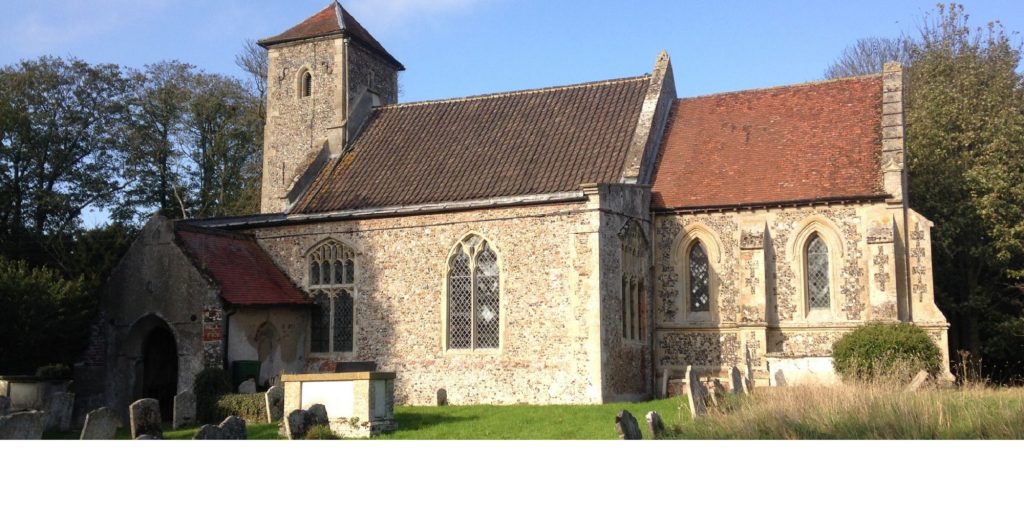
St Andrew’s Church – A Request for Help
Fersfield Parish Church
Fersfield St Andrew is an Ancient Parish in the Redenhall deanery of the Diocese of Norwich. Fersfield has been variously recorded as Fersevella, Fervessella, Ferefeud, Fairfeud, Fairvill, and Fersfell, all which seem to signify a Fair Fee, or Village. The village was, however, recorded in the Domesday Book under Fersfield.
The church is dedicated to Saint Andrew, and dates back, at least in part, to the 12th century. It holds a plain Norman font and a painted wooden effigy of Robert du Bois.
So what is the purpose of this post?
Simply put, our ancient Church, which has been the centre of our village and has witnessed weddings, burials, christenings and national celebrations for so long is now in need of your help.
Regardless of whether you are a regular attendee or come along just for Christmas Carols or just don’t want to stand by and see our village Church close, your help is important in making sure that the Church is handed onto the next generation and that its continuity as a living part of our village is assured.
For those of you who were unable to attend a recent meeting (15th July) held at the Church, the purpose of which was to discuss the future, a brief outline follows:
The meeting was chaired by Canon The Reverend Tony Billet and Reverend John Cruse.
21 people from the village attended and 6 sent their apologies for absence.
Given the size of our village this was a very good turnout and demonstrated a desire that the Church should not close.
The conclusion of the meeting was that:
- Services would be maintained albeit at a reduced level.
- We should endeavour to keep alive those traditional services particularly concerning Harvest and Christmas
- Research needed to be done to see what other communal uses the Church building could be put to.
- There was an overriding sense that whatever is done it should be done as a community rather than as the domain of one or two people.
Needless to say, if the above expressed wishes of the meeting are to come to a positive conclusion then firstly, we have to raise money and secondly we need volunteers to help in the day to day running of the Church.
Examples of the type of work that needs to be done are:
- Help with cleaning,
- Flower arranging,
- Key holders
- Light gardening work
- Inspection of Fabric
- Car parking and so on.
Already a significant number of people have put their names forward to help in all of the above areas and in others not mentioned, however more volunteers would help to lighten the load.
Attached to this letter is a brief questionnaire which it would be appreciated if you could complete and return to Paul Sumpter, Walnut Tree Barn, Bates Lane, IP22 2FB.
If you have any questions Paul can be contacted on 01379 687711 or paulsumpter1@gmail.com. All enquiries will be treated in strictest confidence.
Thank you for taking the time to read this letter,
Kind regards
Paul Sumpter
Acting Church Warden
How you can Help
- I would like to make a regular monthly donation to Fersfield Church. I understand that my donation will only be used for the purposes of ensuring Fersfield Church remains open. The below figures are only indicative, whatever you can afford will be really appreciated. Please indicate the monthly amount that you feel able to give.
- £5
- £10
- £15
- £ you specify the amount
- I would like to be considered for appointment as a Church Warden. Yes/No
- I would like to be considered for appointment onto the Parish Church Council (PCC) Yes/No
- I would like to be a member of a Steering/Fundraising committee Yes/No
- I would like to be a volunteer for a specific task. Please indicate your preference.
Your help is really appreciated in keeping our Church open for the all of our community.
Please return to:
Paul Sumpter
Walnut Tree Barn
Bates Lane, Fersfield
